Sixty-five percent of iOS app downloads start with a search inside the App Store — and most founders who built their apps on Bubble, Glide, or FlutterFlow haven’t touched a single piece of that metadata since launch day. That’s not a small oversight. It’s the gap between a stagnant app and one that compounds. Mobile app growth hacking is often framed as a developer’s game: custom referral logic, engineering-heavy analytics pipelines, two-week sprint cycles for testing UI changes. That framing excludes the fastest-growing category of app builders. No-code platforms cut development time by up to 90%. By 2026, 70% of new enterprise apps will use no-code or low-code technology. The tools have changed. The growth playbook needs to catch up. The ten strategies below are built for the founder who shipped without code and wants to grow without a full team — whether they built on Bubble, FlutterFlow, or Glide.
Why the No-Code Advantage Is Now a Distribution Advantage?
Growth hacking was coined in 2010 by Sean Ellis. The idea was simple: one north star, measurable user growth. Not brand equity. Not awareness. The original method assumed a developer queue. You form a hypothesis, write a ticket, wait a sprint — two weeks at minimum — deploy the change, then measure. That cycle runs six times a quarter if you’re disciplined.
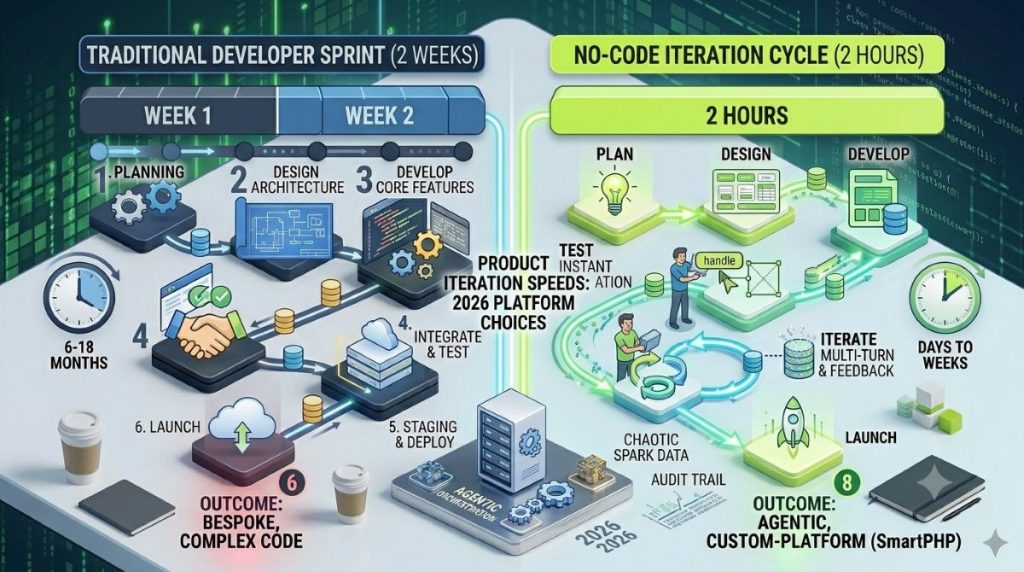
No-code collapses that loop. A Bubble founder can rebuild an onboarding flow in an afternoon. FlutterFlow ships a new screen before the end of a working day. This isn’t just faster — it’s a different game. Growth hacking rewards the teams that iterate most often, not the ones with the most engineers.
That same 90% speed advantage runs through every strategy in this guide. It’s the foundation everything else builds on.
The Mobile App Growth Funnel: Where No-Code Changes Everything
Most app founders approach growth as a download problem. Steve P. Young, founder of App Masters and host of one of the most followed app marketing podcasts, put it plainly in a transcript from his MAU Vegas 2026 debrief: “A lot of times people will just think ‘I need more downloads.’ When they think about growth they always think downloads, downloads, downloads — and they don’t think about the whole entire funnel.”
The funnel is what separates apps that scale from apps that flatline. Every mobile app moves users through six stages:
Acquisition — the user discovers your app through store search, paid ads, referrals, or word of mouth. Activation — they complete the core action that delivers your app’s value in the first session. Engagement — they return and build a usage pattern. Retention — that pattern becomes a habit. This is where most apps fail: Day 7 retention across all app categories averages 11.4% in 2026. The top 10% of apps hold 25% or more at Day 30. Monetisation — they generate revenue through subscription, in-app purchase, or ad exposure. Referral — satisfied users bring new ones, lowering your acquisition cost over time.
Break any stage and the loop collapses. A 10,000-install month means nothing if Day 7 retention is 4%.
No-code platforms don’t just change how you build an app. They change how fast you can run this loop. Rebuilding an onboarding flow to improve activation takes an afternoon, not a sprint. Testing a push notification campaign takes hours. Shipping a new paywall takes one condition in a workflow. At MAU Vegas 2026, Steve P. Young summarised it directly: “With AI making it easier than ever to ship apps, product development is becoming a commodity. Distribution is the new moat.”
The eleven hacks below map to specific stages in this funnel. Each one addresses a measurable lever — conversion rate, retention, ARPU, viral coefficient — rather than a platform feature.
Hack #1 — App Store Optimisation: Free Traffic That Compounds
App Store Optimisation (ASO) is the growth hack with the longest shelf life. Done right, it drives organic installs without ad spend for years. Done carelessly — or ignored — your app stays invisible to most users who would download it.
The numbers are unambiguous: 65% of iOS downloads come from store search, and 58% on Google Play. If your title, subtitle, and keyword fields don’t match what your users type, you’re absent from where most installs happen. Start with free keyword research tools like AppFollow or AppRadar. Find two to three terms with solid search volume and realistic competition. Get them into your title and subtitle.
Visual assets carry significant weight. On iOS, the first three screenshots appear above the fold before a user scrolls — those images handle most of the conversion work. On Google Play, algorithm updates since 2025 have shifted ranking weight from raw download count toward Day 7 retention. Good ASO is now partly downstream of product quality.
Organic search beyond the app stores. ASO gets most of the attention, but Google web search drives a meaningful share of app discovery that most founders ignore entirely. Users search “best budgeting app for freelancers” or “no-code project manager app” on Google — not in the App Store. A dedicated landing page for your app, optimised for these long-tail queries, builds organic referral traffic directly to your store listing. Backlinks from reviews, directory listings, and press mentions reinforce both your web ranking and your store credibility. The compounding effect is measurable: organic ASO optimisation combined with web search presence can reduce paid acquisition costs by up to 60%, per Searchlab’s 2026 app marketing benchmarks. For a no-code founder on a lean budget, that’s the difference between an ad-dependent funnel and one that generates installs while you sleep.
One underused tactic: Apple’s Custom Product Pages. Only 31% of apps use them, yet those that do see App Store conversion lifts up to 8.6% per SplitMetrics data. Apple doubled the CPP limit to 70 pages per app in early 2026 and moved them into organic search results — turning a paid-only feature into a full ASO tool. No-code apps run on the same stores and the same algorithm as developer-built apps. The field is level. If you’re still choosing which platform to build on, our comparison of no-code platforms for MVPs covers the speed and scalability tradeoffs.
Hack #2 — The Pre-Launch Waitlist: Build an Audience Before the App Exists
Most no-code founders launch cold. The app goes live, the only people who know are LinkedIn contacts, and early traction never builds. A pre-launch waitlist fixes this by building an audience before anything is ready to download.
Build a landing page in under an hour with Carrd, Tally, or Bubble itself. Add a referral mechanic: each signup gets a unique link, and every friend they bring bumps them up the queue. Viral Loops and Prefinery handle this logic without code. Both connect to your no-code platform via Zapier in minutes.
Target a specific launch date and plan a Product Hunt submission around it. Even a top-10 Product Hunt finish drives 500–2,000 installs in 24 hours and gives you the ratings velocity ASO algorithms respond to. The waitlist also gives you an early signal. If people won’t share it before the app launches, that’s data worth having.
Hack #3 — Referral Programs: The Lowest-Cost User Acquisition Channel
Referral programs deliver returns that paid acquisition rarely matches. Referred users have 37% higher retention and 18% lower churn than users from other channels. Deloitte research puts the long-term ROI of well-run referral programs at 312% over three years. Dropbox’s referral program drove 35% of all daily signups at its peak — enough to contribute to 3,900% user growth over 15 months, growing from 100,000 to 4 million users.
The common objection from no-code builders: referral logic needs a developer. It doesn’t. Viral Loops and Referral Hero are no-code referral tools that connect to Bubble or Glide via webhook and Zapier. Reward tracking, unique link creation, and automated email triggers are all handled by the referral tool. Your app delivers the reward — extended free access, bonus credits, a premium feature unlock — when Zapier sends the signal that a referral converted. For building out more complex automation around this, Zapier alternatives like Make offer more generous free tiers at higher task volumes.
Dual-sided rewards convert at higher rates than single-sided ones. Both the referrer and the new user need to gain something concrete. The setup takes an afternoon. It’s one of the highest-return mobile app growth hacking techniques available at any stage.
Hack #4 — Push Notifications: The Retention Lever Most Builders Leave Off
The data here is direct. Apps that send no push notifications lose 95% of opted-in users within their first 90 days. That’s 95 cents of every dollar spent on user acquisition, gone in three months.
One change shifts this significantly. Sending a single well-timed notification in a user’s first week increases two-month retention by 71%. It brings users back at the moment they’re most likely to build a habit — before the memory of why they downloaded the app fades.
Targeted notifications work better than broadcasts. Behaviour-based messages generate roughly 39% user retention versus 21% for generic pushes. A user who finished onboarding needs a feature tip. A user who never completed setup needs a different message. Segmentation is the difference.
Platform notes: Bubble includes native push support. FlutterFlow configures push directly in its build settings. Glide apps route notifications through OneSignal via Zapier. Hard limit to respect: 64% of users stop using an app that sends more than five notifications weekly. Frequency without relevance is the fastest path to uninstalls.
Hack #5 — Freemium Architecture: Design Your Free Tier as a Growth Engine
Freemium apps convert at a 2.18% median rate; hard paywall apps average 12.11%. Those numbers look like a case against freemium. Read them differently, and they’re a case for designing freemium with care.
Freemium’s advantage isn’t conversion rate. It’s volume and virality. A free user who shares your app with ten people and converts none of them is still net positive if word-of-mouth drives five downloads. The model breaks when the free tier is too thin — users leave before experiencing enough value to share — or too generous, removing any reason to upgrade.
The design rule for android app growth hacking and iOS alike: make the free experience worth sharing, and make the upgrade path visible and friction-free. In Bubble, gate premium features using conditional visibility — the feature appears in a locked state that clearly shows the upgrade path. Glide uses role-based access to deliver different experiences per tier. FlutterFlow applies conditional widgets. None of these require code.
Hack #6 — Rapid A/B Testing: Ship Faster, Convert More
Growth hacking strategies for app development are hypothesis-driven: form an idea, test it, measure the result, ship or discard. The bottleneck in developer-built apps is the gap between forming the hypothesis and getting data back. Two-week sprints limit you to roughly six meaningful tests per quarter.
A Bubble founder runs the same process in two hours. Test whether asking for a name before an email drops your activation rate — change it and know within 48 hours. Test whether “Start your free trial” outperforms “Try for free, cancel anytime” on your paywall. Swap it. Measure it. Ship it.
Mixpanel and Amplitude both have free tiers and no-code-friendly integrations. Bubble connects to Mixpanel natively. Use them from day one — iterating without instrumentation means changing things without knowing whether they worked.
Hack #7 — Automated Onboarding: Turn Installs Into Activated Users
Day 30 app retention averages 2.82–3.10% across platforms (Pushwoosh Benchmarks, 2025). Most apps lose the bulk of their acquired users within the first month. The highest-leverage point to intervene is the onboarding window.
A user who doesn’t reach their “aha moment” — the first real experience of the app’s core value — within their first three sessions will almost certainly stop opening it. Automated onboarding emails extend that window past the app session. A three-message sequence covers the gap: Day 0 welcome with one specific action to take. Day 2 feature tip. Day 5 social proof with a soft upgrade prompt.
No-code setup: Zapier monitors your app’s sign-up webhook and triggers a Mailchimp sequence. The timing sits in Zapier’s workflow — no custom email code, no ongoing developer work. It runs from the moment your first user signs up. Our guide to no-code automation tools covers additional platforms if you’re working outside the Zapier ecosystem.
Hack #8 — Community-Led Growth: Your Users as Your Marketing Team
Mobile app growth hacking often focuses entirely on in-app tactics. Community-led growth is the reminder that most discovery is still social.
Build a Discord, Slack, or Circle community before you have real traction. Founders who wait until 1,000 users miss the window when early users are most likely to become advocates. Pre-traction users who feel consulted feel ownership. That sense of ownership drives word-of-mouth that ads can’t replicate.
Reddit takes patience. Find the two or three subreddits where your target users spend time. Contribute for four to six weeks. Then mention your app when it fits a thread directly. Premature self-promotion in tech subreddits gets flagged and removed. Patient participation gets noticed.
The no-code platforms are also channels. The Bubble Community, Glide’s forums, and FlutterFlow’s Discord each have active sections for builders sharing what they’ve made. A polished, useful app shared there consistently drives installs, feedback, and early credibility.
Hack #9 — Ratings and Reviews: The Conversion Multiplier
Apps that moved their rating from 3.6 to 4.2 saw nearly 60% higher conversion rates. AppTweak data shows that 90% of featured apps on both stores hold ratings of 4.0 or above. A strong rating is more than social proof — it’s a direct ranking input for the algorithm.
The most effective way to collect better ratings is to trigger the in-app review prompt after a user completes a meaningful action, not at random app opens. A user who just accomplished something is far more likely to leave a positive review than one interrupted mid-task.
In Bubble, a conditional workflow fires the review request after a defined key event. FlutterFlow supports in-app review natively. Glide apps running as PWAs use browser prompt APIs. The mechanics vary. The impact on conversion does not.
Hack #10 — Analytics: Track What Actually Drives Revenue
Growth hacking for mobile app development runs on data. Most no-code founders rely exclusively on their platform’s default analytics — Bubble’s activity dashboard, Glide’s basic metrics. These show activity. They don’t show growth signals.
Before tracking product usage, nail down your unit economics. Three numbers define whether your app’s growth is viable or just busy:
LTV:CAC ratio. Lifetime value divided by customer acquisition cost. The industry benchmark for sustainable mobile app growth is 3:1 — meaning every dollar spent acquiring a user should generate three dollars in lifetime revenue. The meditation app Calm achieved a 3:1 ratio at scale, which the Pujji brothers highlighted in a widely circulated unit-economics breakdown. Top-performing subscription apps reach 5:1. Ratios below 2:1 mean you’re subsidising growth with capital rather than building a business.
ARPU. Average revenue per user, typically calculated monthly. The 2026 global average for mobile subscription apps is $8.41, per RevenueCat’s State of Subscription Apps report. Your ARPU directly sets the ceiling on how much you can afford to spend acquiring a user. If your ARPU is $5/month and your paid CPI is $4, you’re already operating with a thin margin before factoring in churn.
Payback period. How many months of revenue does it take to recoup your acquisition cost? Most operators target under 12 months. Subscription apps that hit payback in under 6 months have a structural advantage — they can reinvest revenue into the next acquisition cycle faster.
For no-code founders, these three numbers belong in your analytics dashboard from day one — not from the day you raise a round. They’re the signal that tells you whether to double down on a growth channel or change direction.
Three metrics matter most at early stage. Activation rate: did the user complete the core action in session one? Day 7 retention: is the app forming a habit? Feature adoption by segment: which users get value from which features? Platform dashboards don’t answer these.
Mixpanel and Amplitude both integrate with major no-code platforms. Bubble connects to Mixpanel natively. Glide routes events through Zapier to Amplitude. Both tools have free tiers that cover early-stage volume. If you’re comparing what’s available before committing, our best no-code analytics tools overview breaks down the options. Set up three to five key event trackers from the day you launch — not two months later. If activation rate is below 40%, that’s the problem to fix before any other growth tactic. Everything else is downstream of users actually experiencing the app’s value.
Hack #11 — Paid User Acquisition on a No-Code Budget
Global spend on mobile app user acquisition crossed $94 billion in 2026. Most of that belongs to companies with dedicated UA teams, six-figure monthly budgets, and data science pipelines. None of which describes a no-code founder six weeks post-launch.
That context matters, because it shapes how to approach paid acquisition at the early stage. You’re not running a scaled campaign. You’re buying data.
What CPI Actually Means for Early-Stage Apps?
CPI — cost per install — is the headline metric in paid UA. The 2026 global average sits at $2.24 on iOS and $1.12 on Android. Those numbers mean very little without retention context. The insight that changes how most founders think about paid spend comes from AdAction’s 2026 acquisition cost analysis: a $4.00 CPI with 5% Day 30 retention costs you $80 per retained user. A $6.00 CPI channel that delivers 15% Day 30 retention costs only $40 per retained user — half the price, despite the higher nominal CPI. The cost per retained user is the metric that matters. CPI alone is a trap.
For early-stage no-code apps, the goal of a first paid campaign is to find which channel delivers the lowest cost per retained user — not the cheapest install. Run $200–$500 across two channels. Measure Day 7 retention by source. Double down on the channel with better retention. Repeat.
The Three Channels Worth Testing First
Apple Search Ads (ASA) targets users who are already searching the App Store for apps like yours. Intent is high, and quality of users typically outperforms social ads on retention metrics. Start with exact-match keywords from your ASO research. Budget: $5–$10/day is enough to generate meaningful data within two weeks.
Meta (Facebook/Instagram) offers the broadest reach and the most granular audience targeting. Facebook CPI sits between $0.87 and $4.73, per Revealbot data. The trade-off post-ATT: iOS targeting is weaker, so creatives carry more weight. A short native-style video showing a specific problem your app solves outperforms polished brand ads at this stage.
Micro-influencers are the underused channel. Creators with 1,000–100,000 followers in your app’s niche drive higher-trust installs than broad ad networks — and cost significantly less. A fitness app working with 30 wellness micro-influencers generated 70,000 downloads in two months with a 14% premium subscription conversion rate, per AWISEE’s 2025 campaign analysis. A budgeting app using small finance TikTokers reported 6x return on ad spend versus paid Facebook ads. The ceiling on micro-influencer ROI is real for small apps: the audiences are small, so don’t expect scale. Expect quality.
The No-Code Retargeting Approach
Retargeting — showing ads to users who installed but went dormant — is typically reserved for teams with custom data layers. For no-code apps, it’s simpler than it sounds. Bubble apps can push user events to Mixpanel or Amplitude via native integration. From there, custom audiences can be synced to Meta using Zapier or Make. A dormant user who hasn’t opened your app in 14 days can be shown a push notification via your platform’s native tools, or a retargeting ad on social — no custom SDK required. The re-engagement conversion rate on retargeting campaigns averages 3–5x higher than cold acquisition. For an app losing users after day 7, this is the highest-ROI spend available.
Choosing the Right Hacks for Your App’s Stage
Running all ten at once is a reliable way to do none of them well. Stage order matters.
Pre-launch: Hacks #1 (ASO metadata), #2 (waitlist), and #10 (analytics setup). These are the foundation — everything else builds on top of them. If you’re still in the process of building, our Bubble beginner tutorial covers the platform setup from scratch.
Just launched (under 100 users): Add Hacks #7 (onboarding sequence) and #9 (ratings). The primary problems at this stage are activation and early social proof.
Early traction (100–1,000 users): Add Hacks #3 (referrals), #4 (push), and #6 (A/B testing). You now have enough users to generate referral data and enough behaviour history to make segmented notifications meaningful.
Growth phase (1,000+ users): Introduce Hacks #5 (freemium architecture), #8 (community), and #11 (paid acquisition). By this stage you have enough retention data to identify which paid channels deliver the lowest cost per retained user — the condition that makes paid spend viable rather than a drain. These are volume strategies — the returns compound as the user base grows.
Conclusion
No-code doesn’t just speed up building apps. It speeds up the entire growth loop — the cycle of hypothesise, test, measure, and iterate that separates apps that compound from apps that flatline. A growth team in a traditionally built app waits two weeks for a UI change. A no-code founder ships it this afternoon.
The ten hacks above work for developer-built apps too. For no-code builders, the feedback loop is shorter, the cost to implement is lower, and the tooling is already within reach. ASO, referral programs, push notifications, automated onboarding — these aren’t tactics reserved for funded teams. They’re the standard infrastructure for any app that intends to grow.
Pick one hack from this list. Implement it this week. Measure it for thirty days. That’s the discipline.
Frequently Asked Questions
ASO is the highest-priority move at launch. Sixty-five percent of iOS downloads start with a store search, which means your app’s metadata is your most important marketing asset from day one. Configure your title, subtitle, and screenshots before promoting anywhere else. Pair this with a three-email onboarding sequence built in Zapier and Mailchimp so that the installs you generate have a structured path to activation.
Yes. Both the App Store and Google Play evaluate apps on identical criteria regardless of how they were built: keyword relevance, download velocity, ratings, Day 7 retention, and crash rate. A Bubble app and a Swift app compete on the same ranking inputs. No-code apps that crash often or retain users poorly will rank accordingly — but those are product quality problems, not platform disadvantages.
Use a no-code referral platform — Viral Loops and Referral Hero are both well-suited. They generate unique referral links, track conversions, and trigger reward delivery via webhooks. Connect them to your app through Zapier: when a referral converts, Zapier sends your app an event that unlocks the reward for the referrer. The setup takes a few hours rather than a few weeks.
Mixpanel and Amplitude are the two most common choices. Bubble connects to Mixpanel natively. Glide routes custom events to Amplitude through Zapier. Both tools have free tiers that cover early-stage volume. From day one, instrument your activation event, your Day 7 retention, and your most-used feature. Those three data points drive most early-stage growth decisions.
One to two per week is the right range for early-stage apps. Sixty-four percent of users stop using an app that sends more than five notifications weekly. Quality and timing matter more than frequency. A single behaviour-triggered push — sent when a user hasn’t opened the app in three days, for example — consistently outperforms three generic weekly broadcasts.
The 2026 global average CPI is $2.24 on iOS and $1.12 on Android, but the number that matters more is cost per retained user — what you pay per install divided by your Day 30 retention rate. A channel delivering users at $4 CPI with 5% Day 30 retention costs $80 per retained user. One delivering users at $6 CPI with 15% Day 30 retention costs $40. Apple Search Ads typically delivers the highest-intent users; Meta’s Facebook/Instagram ads offer the broadest reach. For early-stage no-code apps, a test budget of $200–$500 across two channels — measured by Day 7 retention per source — gives enough data to make a meaningful allocation decision.