

The US is projected to have 1.4 million unfilled software developer positions by 2026. McKinsey estimates a 4.3 million shortfall globally. Universities and bootcamps will fill roughly half that gap, according to 2026 data from Kissflow. That structural reality drives no-code developer hiring to the top of many founders’ lists. Teams that once would have waited 6 months for a development resource are now shipping functional no-code apps in weeks — and they’re hiring specialists to do it faster and more reliably.
But demand alone doesn’t make the process easy. Post a job on a major freelance platform today and you’ll receive 30 proposals within 48 hours. Most of them come from generalist developers who listed “Bubble” or “Webflow” somewhere in their profile. The quality gap between a skilled no-code specialist and a generalist who watched a few YouTube tutorials is enormous. It doesn’t show up until month three of a build, when the structure breaks down and a full rebuild costs two to five times the original project budget. A 2024 Gartner survey found that 43% of citizen developer initiatives had been scaled back or shut down within three years of launch — not because the platforms failed, but because the builds were poorly structured from the start.
This guide maps the 12 best places to hire no-code developers in 2026, organized by type: open freelance marketplaces, vetted talent networks, platform-native expert directories (the most underused channel), and specialist agencies. At the end, you’ll find a decision framework that matches your project type to the right hiring channel — the step most guides skip entirely.
Why the “Just Post on Upwork” Approach Breaks Down?
There are two fundamentally different types of places to hire no-code developers. Open general marketplaces give you volume: thousands of profiles, low friction, quick proposals. Vetted niche platforms and specialist directories give you signal: smaller pools, higher average quality, slower but more reliable matches. Mixing them up is expensive.
The problem with defaulting to open platforms is structural. Top-tier no-code developers actively avoid places like Upwork and Fiverr to escape bidding wars that push rates down and attract clients who buy on price alone. What you see on a general platform is not a fair sample of the no-code talent market. It’s the part of the market willing to compete on price.
There’s also a specialization problem. “No-code developer” is not one skill set. Bubble expertise doesn’t transfer to FlutterFlow. A Webflow specialist who builds great marketing sites may have no idea how to design a relational database for a two-sided marketplace. Hiring a generalist for a platform-specific build is the top cause of the rebuilds that cost founders two to five times their original project budget.
For a Smart Admin, the takeaway is blunt: more profiles doesn’t mean better options. The hiring channel should match the project’s platform and complexity — not your comfort with a familiar website.
What Type of No-Code Developer Do You Actually Need?
Before opening any platform, decide which engagement model fits your situation. Getting this wrong wastes more time than a bad platform choice.
Freelancers are right for bounded projects: a specific automation, a landing page in Webflow, a feature added to an existing Bubble app. Scope needs to be written out before you hire. Vague scope with a freelancer typically ends in a dispute.
Agencies are right for complex builds: multi-user web SaaS with payment flows, a mobile app, a two-sided marketplace. Agencies bring structured delivery, design accountability, and usually QA testing. These things matter more as complexity grows. Agencies cost more upfront and save money on rebuilds.
In-house no-code specialists make sense for companies with recurring internal tool needs: ops teams building dashboards, HR teams setting up onboarding flows, marketing teams iterating on landing pages. The ongoing need justifies the ongoing cost.
If you’re still deciding whether to build at all, it helps to review the best no-code platforms for MVPs before locking in a developer type — the platform you choose directly determines who you should hire.
Platform choice comes before hiring. As LowCode.agency argues from 320+ builds: Bubble fits complex web SaaS with relational data; Glide fits internal data-driven tools backed by spreadsheets; FlutterFlow fits mobile-first native apps for iOS and Android; Webflow fits design-forward marketing sites. Lock this in before you start sourcing, and you’ll filter candidates much faster.
The rule most guides won’t give you: if you can’t clearly define the core features of the first version right now, you’re not ready to hire. You’re ready to validate. Hiring before scope is clear is the most expensive mistake in early-stage product development. This point is worth sitting with.
12 Best Places to Hire No-Code Developers in 2026
The platforms below fall into four categories: general freelance marketplaces, vetted talent networks, platform-native expert directories, and specialist agencies. Each one serves a different project profile and budget range.
General Freelance Marketplaces
These are the high-volume, lower-barrier options. They work best when you have clear scope, a set budget, and the ability to evaluate candidates on your own.
1. Upwork — The Open Market
Upwork is the world’s largest freelance marketplace and has a well-stocked no-code developer category spanning Bubble, Webflow, FlutterFlow, Make, and Zapier specialists. Volume is its strength. Quality variance is its weakness.
When hiring here, filters matter more than the platform itself. Look for: a Job Success Score above 90%, the Bubble Certified Freelancer badge where it applies, a portfolio of database-driven apps (not just UI screenshots), and a work history with completed no-code projects. A developer with 400 five-star reviews for logo design and one Bubble project listed as a skill is not a Bubble specialist. The distinction is important.
Rates range from $15 to $100/hr, with experienced specialists at $40–$60/hr. Upwork’s service fee adds 5–20% on your end, so budget for that.
Best for: bounded projects with a documented spec, budgets under $5,000, clients who can judge no-code work quality on their own. Limitation: top talent avoids it; quality filtering is on you.
2. Fiverr — The Gig Layer
Fiverr’s gig-based model makes it the right tool for narrow, well-defined tasks. A specific Zapier flow. A Webflow landing page. A Make scenario connecting two APIs. For that scope, Fiverr is fast and cost-effective.
Where Fiverr breaks down is on anything that needs design decisions: database structures, user roles, multi-step workflow logic. The platform rewards speed and low price. Those are the wrong priorities for complex builds. The seller’s incentive is to close the gig, not to ask hard questions about your data model.
Rates: $25–$500 per gig at the lower end; some sellers offer larger project packages.
Best for: single-feature tasks, automations, simple Webflow builds, testing a developer on a small paid task before a larger hire. Limitation: not built for complex work; quality documentation is rare.
3. Contra — The Commission-Free Option
Contra is a commission-free freelance platform: neither client nor freelancer pays a platform fee. That model attracts a different type of developer — builders who can set their own rates without accounting for Upwork’s fee cut.
The no-code pool on Contra skews toward modern-stack builders: Webflow specialists, Bubble freelancers, and automation builders using Make and n8n. Profile quality for web-focused no-code work is slightly above average compared to Upwork. The platform’s design tends to attract product-minded freelancers.
Best for: Webflow-forward and design-adjacent no-code work; founders who want to skip Upwork’s fee layer while still reaching a broad freelance pool. Limitation: smaller total talent pool than Upwork; vetting is less structured.
Vetted Talent Networks
These platforms screen candidates before listing them. You pay more per hour, but spend much less time sourcing and filtering.
4. Arc.dev — The Screened Specialist
Arc.dev claims to place the top 2.3% of freelance no-code developers within 72 hours, with access to 450,000 talent profiles across 190 countries. Three service tiers exist: full-time vetted hire (new options every two weeks), top-2.3% freelance placement with weekly payments, and a free job post tier that reaches the broader unvetted pool.
The key benefit for non-technical founders is pre-screening. Arc checks platform experience, portfolio quality, and communication skills before a developer appears in your results. Bubble, Webflow, and FlutterFlow specialists are clearly tagged. If you can’t judge on your own whether a developer truly knows Bubble’s database model or is just claiming to, Arc’s vetting layer is worth the rate premium.
Rates: $50–$120/hr on the vetted tier.
Best for: founders without technical no-code evaluation skills; mid-to-senior quality needs without an internal HR process.
5. Toptal — The Premium Tier
Toptal’s pitch is the top 3% of all freelance talent, with a multi-step screening process and a trial period model. You only start paying after you’ve confirmed the developer fits your project. Their Bubble developer roster is active; their rates reflect the vetting investment.
Rates run $80–$230/hr. That’s too much for a $5,000 MVP validation build. It’s the right call for enterprise-grade internal tools, mission-critical automation, or funded product teams where a bad hire creates real downstream risk. Teams evaluating enterprise no-code development at scale tend to find Toptal’s quality guarantee worth the premium.
Best for: enterprise-grade no-code builds, funded startups, clients who need maximum quality assurance. Limitation: the cost premium is real, and not always justified by project scope.
6. Ellow.io — The AI-Matched Marketplace
Ellow.io pairs AI-powered matching with human recruiter review across a pool of 25,000+ global experts, with a claimed 48-hour match. Rather than sorting through bulk applications, Ellow gives you a pre-screened shortlist based on your project needs.
The positioning sits between open platforms and premium networks: more quality signal than Upwork, less price premium than Toptal. Profiles include verified work history and platform skill data.
Best for: teams that want fast placement with some quality assurance; mid-budget projects ($5,000–$30,000) where a quick match-to-start timeline matters. Limitation: smaller developer pool than Arc or Toptal; vetting criteria are less transparent.
Platform-Native Expert Directories: The Underused Channel
This category barely appears in competing guides. That’s exactly why it deserves your attention. Platform-native directories are curated by the platform itself, meaning credential checks are real — not self-reported. For platform-specific projects, this is the highest-signal hiring channel available.
7. Bubble Agencies Directory — The Official Source
Bubble.io maintains an official Agencies directory: a curated list of development shops and solo builders verified by Bubble itself. The directory spans solopreneurs to shops with 10+ developers. All have shown real Bubble deployment experience, not just profile claims.
For any project built on Bubble, this is the best starting point. No platform fee, no bidding war, direct contact with agencies whose skills Bubble has actually checked. The range covers budget-accessible freelancers through enterprise-grade shops, so the directory works across a wide cost range.
What you won’t find here: developers whose “Bubble experience” is self-reported on a general marketplace profile. That distinction matters for any serious build. For reference on what competent Bubble builders typically work with, the best Bubble plugins guide gives a sense of the ecosystem depth any serious Bubble developer should know.
Best for: Bubble SaaS products, marketplaces, CRMs, and portals — any project where Bubble is the primary platform. Limitation: Bubble-specific only; not useful for Webflow, Glide, or FlutterFlow projects.
8. Glide Experts Directory
Glide maintains its own partner network of certified experts. The focus here is narrow but important. Glide builds are typically internal data-driven tools: ops dashboards, field service apps, inventory managers, backed by a Google Sheets or Airtable data source. That’s a specific use case, and the Glide directory connects you with builders who have real experience in it.
Hiring a Bubble specialist for a Glide project creates the same mismatch as hiring a React developer for a Laravel app. The logic is different. The data model assumptions are different.
Best for: internal tool development; ops teams building on a Google Sheets or Airtable backend.
9. FlutterFlow Certified Partners
FlutterFlow’s partner program certifies mobile no-code developers who have passed FlutterFlow’s own skill checks. This is the right first stop for any mobile-first no-code project — iOS and Android apps built without traditional code.
Bubble expertise doesn’t apply here. FlutterFlow is a mobile development environment. The structure, the state management, and the deploy process are all distinct. If you want a mobile no-code app, you need a FlutterFlow specialist. A Bubble developer who “also does mobile” is not that.
Best for: native mobile apps for iOS and Android using no-code. Limitation: partner directory is smaller than Bubble’s agency list; for complex mobile projects, supplement with LowCode.agency or Arc.dev.
Specialist No-Code Agencies
Agencies bring something freelancers rarely can: a full product team handling scoping, design, development, and QA under one structure. The cost is higher. The outcome is more predictable for complex projects.
10. Airdev — The Bubble Powerhouse
Airdev is a San Francisco-based agency widely cited in no-code communities as one of the largest and most experienced Bubble development shops around. They run as a full product team, handling project scoping, UI/UX design, development, and quality assurance — not just developer placement.
Their portfolio covers the full range of Bubble use cases: two-sided marketplaces, CRMs, SaaS platforms, learning management systems, and B2B portals. If your project is a production-grade Bubble app with real users, payments, and complex data logic, Airdev is one of the most credible options in the market.
Rates are project-based — $20,000–$100,000+ depending on scope. This is not the option for a $3,000 MVP validation build. It is the right option for funded teams building a product designed to scale.
Best for: funded startups and enterprise teams building complex Bubble products; projects where design quality and long-term stability are the top criteria.
11. LowCode.agency — The Multi-Platform Shop
LowCode.agency has built 320+ apps across Bubble, Glide, FlutterFlow, and Webflow, and they publish the most detailed no-code hiring and platform-selection guides in the ecosystem. That breadth of platform coverage is their main edge. If you haven’t committed to a platform yet and need a team that can guide tool selection as well as execute the build, LowCode.agency is the most useful option on this list.
They handle MVPs, full-scale builds, and AI automation integrations added to existing no-code apps. That last category is a growing need as teams want to add AI features to products built without them. Their published guides also let you assess their thinking before committing — a meaningful due diligence signal.
Best for: early-stage founders who need platform guidance plus execution; multi-platform projects; teams adding AI and automation layers.
12. CloudEmployee — The Staff Augmentation Play
CloudEmployee places dedicated no-code specialists inside your team rather than delivering projects. The developer works embedded in your workflow. CloudEmployee handles contracts, payroll, IP protection, and compliance in the background.
Their no-code roster covers Webflow, Bubble, Airtable, Zapier, and Make. This is useful for ops teams that need a no-code person “on the team” on an ongoing basis, not just for one build. They’re not the right fit for a one-off project. They’re the right fit for a company with recurring no-code needs that doesn’t want to deal with full-time employment costs.
Best for: growing companies with ongoing no-code development needs; teams that want embedded talent rather than per-project delivery.
How to Choose the Right Platform for Your Project?
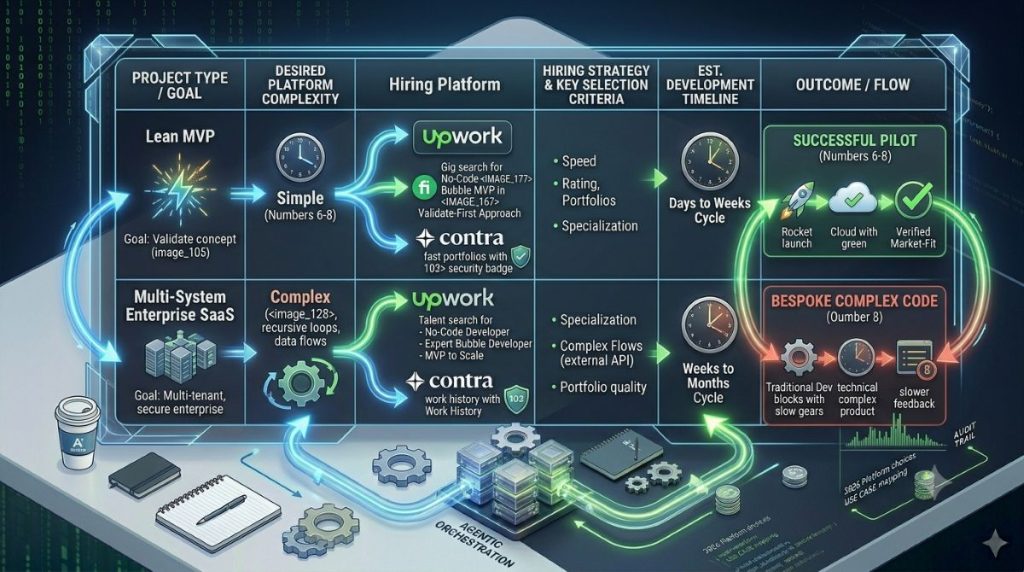
Most guides list platforms and leave the matching decision to you. This section doesn’t.
Project type 1: Mobile-first native app (iOS/Android) → Start with FlutterFlow Certified Partners. For more complex scope, LowCode.agency’s FlutterFlow team is the most documented option. Bubble expertise doesn’t transfer here — make that clear in any hiring conversation.
Project type 2: Complex web SaaS (user accounts, roles, relational data, payment flows, APIs) → Bubble Agencies Directory first, then Airdev for production-grade builds, or Arc.dev for vetted freelancers. A general platform freelancer at $25/hr is the highest-risk choice for this scope. The rebuild math doesn’t work in your favor.
Project type 3: Internal data tool or operations dashboard → Glide Experts Directory, or a Glide/Airtable specialist sourced through Arc.dev. This category has lower rates and faster build timelines. It’s the one case where a carefully-filtered Upwork hire can actually work.
Project type 4: Marketing site or design-forward content build → Webflow freelancers via Upwork, Contra, or Fiverr. This is primarily a design task. Quality Webflow specialists are accessible on general platforms in a way that Bubble specialists are not.
For hybrid projects (a Bubble app with a Make automation layer and an Airtable backend, for example), name the primary platform when hiring. Generalists who claim all three rarely do any of them well above a junior level.
No-code platforms have been shown to reduce app development time by up to 90% compared to traditional development. That speed gain only happens with a developer who knows the platform’s design patterns. A generalist learning on your budget absorbs that benefit before you see it.
Pricing Reality: What You’ll Actually Pay?
Rate ranges in 2026 vary widely by channel.
On general platforms (Upwork, Fiverr, Contra), no-code developer rates run $15–$100/hr. ZipRecruiter’s 2026 data puts the US average at $52.84/hr, with most experienced workers earning $40–$65/hr. Offshore developers on the same platforms can be found at $15–$30/hr.
On vetted networks (Arc.dev, Toptal, Ellow), expect $60–$230/hr depending on tier and seniority. The premium reflects screening cost, not always a direct quality jump. For founders who can’t judge no-code skill on their own, the screening premium has real practical value.
Agencies (Airdev, LowCode.agency) charge project-based rates. A well-scoped Bubble freelancer project typically runs $900–$5,000; an agency build runs $10,000–$50,000, depending on feature complexity and design scope.
The number most founders underweight: the total cost of a bad hire. A $2,000 Bubble build by an under-qualified freelancer that needs a full rebuild costs $15,000–$25,000 to fix, if it can be fixed without starting over. The cheapest hire has historically been the most expensive outcome. Design decisions made in hour one of a build compound across every hour that follows.
What good value looks like for a Smart Admin: a clean database structure, clear API integration docs, and a handover that lets a second developer understand the build without calling the original one. Those qualities don’t show up in an hourly rate comparison. They show up in the rebuild cost three months later.
What to Check Before You Hire?
A portfolio review and a 30-minute call are not enough to filter a no-code developer hire. Three additional steps separate good hires from expensive lessons.
Portfolio audit — what to actually look for. Screenshots of finished apps are easy to fake. What’s harder to fake: evidence of database modeling decisions, multi-user role structures, API integrations, and workflow logic. Ask for a walkthrough of the data types behind an app they built, not just the front-end. A developer who struggles to explain their database structure for a project in their own portfolio is showing you something important.
Paid trial task. Before committing to a full project, give the candidate a small bounded task from your actual spec — not a generic test. Budget $150–$300 for this. The trial shows how someone builds under real conditions: do they ask clarifying questions? Do they document what they built? Do they make sensible tradeoffs? Interviews reveal communication style; trial tasks reveal execution quality. This single step catches more bad hires than any interview question will.
Platform certifications. Check for: the Bubble Certified Developer badge, FlutterFlow partner certification, and Webflow Expert status. These aren’t quality guarantees, but they filter for developers who take the platform seriously enough to pursue formal credentials.
Red flags in any hiring conversation: vague estimates without questions about your data model, a portfolio with only front-end screenshots and no evidence of backend logic, resistance to a small paid trial, and rates far below market with explanations that don’t hold up.
Conclusion
The right hiring channel depends more on your project type and platform than on any platform’s raw talent volume. Upwork has more profiles than the Bubble Agencies directory — but for a production Bubble SaaS, the directory is the better starting point by a wide margin.
The no-code hiring market is still maturing. Platform-native directories will improve as Bubble, FlutterFlow, and Glide grow their certified developer ecosystems. Vetted networks will add more platform-specific screening. Specialist agencies are already building track records comparable to traditional software shops for quality assurance.
For now, the practical path: identify your platform first, then match your hiring channel to your project type using the framework above. The decision matrix isn’t glamorous. But it’s the difference between a product that ships in six weeks and a rebuild conversation in month three. If you’re still scoping which platform to build on, this overview of no-code app development is the right starting point before you hire.
Frequently Asked Questions
Rates vary by platform and developer seniority. On open platforms like Upwork and Fiverr, expect $15–$100/hr; the US average sits at approximately $53/hr according to ZipRecruiter’s 2026 data. Vetted networks like Arc.dev and Toptal run $60–$230/hr. Project-based agency work typically runs $5,000–$50,000 depending on scope and complexity. Factor in revision cycles and build quality when comparing rates — the lowest hourly rate rarely produces the lowest total cost.
A freelancer is a single developer who handles their own project management, design, development, and testing. Right for bounded, well-scoped projects at lower rates ($900–$5,000 per project range). An agency brings a structured team — scoping, design, development, and QA — under one delivery process. Better for complex builds, long-term products, and situations where design accountability matters. Agencies charge more upfront and tend to produce better outcomes for production-grade products.
Start with Bubble’s official Agencies directory (bubble.io/agencies) — it’s the highest-signal channel because credentials are platform-verified, not self-reported. For vetted individual freelancers, Arc.dev has a dedicated Bubble specialist roster. Upwork has volume but requires heavy filtering. For production-grade builds, Airdev and LowCode.agency are the specialist agency options with documented Bubble track records.
Yes, but you need a FlutterFlow or Adalo specialist — not a Bubble or Webflow developer. Mobile no-code is a distinct skill set. FlutterFlow’s Certified Partners directory is the best starting point for verified mobile no-code talent. LowCode.agency also has a FlutterFlow team for more complex mobile builds. Hiring a Bubble specialist for a mobile project creates the same mismatch as hiring the wrong framework developer in traditional development.
Ask the candidate to walk you through the data model of an app in their portfolio, not just the front-end. A skilled developer will explain which data types they created, why they structured relationships a certain way, and how user roles work. If they can only talk about the UI and not the backend logic, they’re likely a front-end designer using no-code tools, not a no-code architect. Also ask: “What would you do differently if you rebuilt this app today?” The answer reveals experience and product thinking in equal measure.