

Founders building on Bubble have collectively raised over $15 billion in venture funding. And yet a stubborn question persists: can Bubble actually produce a real app? One that holds up, scales, and doesn’t crack under a few hundred users at once?
It can. But that answer only helps if you know what “a real app” looks like for your specific idea. Most Bubble example articles are inspiration galleries — polished screenshots, funding headlines, a numbered list, and no framework for what any of it means for your concept. That two-sided marketplace. That AI tool. That internal dashboard you’ve been sketching on a notepad.
This guide treats each Bubble.io app example differently. If you’re newer to the platform, our Bubble.io beginner tutorial gives you the full orientation first. Every entry comes with the context a non-technical founder actually needs: what category the app falls into, which Bubble feature made it possible, and where the platform’s honest limits are. In 2026, with Bubble’s native mobile builder in public beta and AI integrations now routine, the range of viable examples has also expanded. That context belongs in any current guide.
What Bubble.io Is, and Why It’s Different From Other No-Code Tools?
Bubble.io is a full-stack no-code web app builder. Unlike website builders like Squarespace or Wix, or data tools like Glide, Bubble gives you control over the entire app layer: front-end design, back-end logic, database structure, workflow automation, and API connections — all without writing code.
The platform’s adoption reflects genuine market confidence. Over 7 million apps have been created on Bubble, with more than 6 million active builders using the platform today. The plugin ecosystem covers 8,000+ extensions — Stripe billing, OpenAI connectors, and most third-party services you’d need. Bubble runs on AWS and scales horizontally.
The broader context matters here: Gartner forecasts the low-code market will reach $44.5 billion by 2026, with 70–75% of new enterprise apps expected to use no-code or low-code tools. Bubble sits at the complex end of that range. It has processed billions in financial transactions and served millions of end users.
Bubble.io App Examples by Category
Before the specific apps, here’s the practical map. Bubble’s most proven categories:
SaaS products — subscription tools, dashboards, CRMs, content platforms. The most common Bubble use case by volume.
Marketplaces — two-sided platforms connecting buyers and sellers, job boards, freelancer networks.
Internal tools — custom dashboards, admin panels, workflow managers, scheduling systems. Often the fastest ROI for non-technical operators.
Fintech and enterprise apps — loan platforms, financial workflow tools, compliance systems. These work at scale when structured correctly.
AI-powered apps — tools that connect external AI APIs to a Bubble front-end. A rapidly growing area.
Native mobile apps — new in 2026 (public beta). iOS and Android apps built from the same Bubble project as the web version.
Outside Bubble’s range: real-time multiplayer games, hardware-dependent IoT systems, and consumer mobile apps where native speed is the core product requirement.
SaaS Product Examples
The Career Platform That Proved Subscription Scale
Teal is a career management platform — resume tools, job tracking, application management — built entirely on Bubble. In 2026, Teal counts 2M+ members and has raised over $5M since its early Bubble-built days, initially raising $5M while building on no-code. The platform runs tiered user accounts, personalized content feeds, and Stripe billing at consumer scale.
Business results: 2 million+ members, raised $5M in venture funding while running entirely on no-code — and the product is still on Bubble.
For a Smart Admin looking at Bubble for a subscription SaaS, Teal is the most useful reference. It didn’t reach 2 million users by being a prototype. It got there by shipping features fast and running all of it on Bubble.
What made it viable: user roles and database design let the team build multiple account tiers and personalized content without back-end engineers. Speed of iteration was the edge — not raw technical power.
The AI SaaS That Hit $25K MRR in Six Weeks
My AskAI lets businesses deploy AI agents trained on their own content. The founders reached $25K in monthly recurring revenue six weeks after launch (per Goodspeed Studio’s 2026 SaaS guide). The founders reached $25K in monthly recurring revenue six weeks after launch. By 2026, the platform serves 40,000+ users and has expanded to six-figure ARR with enterprise adoption growing. Many traditionally built SaaS products take a year to hit that milestone.
The structure is worth understanding — and if you’re still deciding whether to build your MVP on Bubble at all, our guide to the best no-code platforms for MVPs maps the full field. My AskAI isn’t an AI platform itself. It’s a Bubble app that connects to external AI APIs, manages user accounts, stores data, and handles billing. Bubble provides the product shell; the AI runs externally. This pattern — Bubble as the product layer, external API as the engine — is the template for most successful AI apps on the platform today.
GoodCourse: Corporate Training Without the Multi-Tool Stack
GoodCourse is a London-based workplace learning platform covering inclusion and harassment training. The team replaced a set of separate tools with one Bubble build. TikTok-style course content, real-time learning analytics, and HR system integrations all live in one place. The founders chose Bubble because it cut the complexity of managing multiple tools for content, user tracking, and reporting.
Business results: Used by enterprise HR teams across the UK and US; the Bubble build replaced a fragmented multi-tool stack and cut operational overhead for the founding team.
For anyone building training or structured content delivery products, this example matters. Bubble handles complex content workflows better than most people assume.
Marketplace and Two-Sided Platform Examples
Comet: From $0 to $800K Monthly Revenue on Bubble
Comet connects tech and data freelancers with companies. The problem it solves is complex: talent screening, project brief management, payments across multiple parties, client dashboards. Comet scaled to $800,000 in monthly revenue on its Bubble-built platform before raising a $13M round. Clients included Société Générale, Renault, and BNP Paribas.
That revenue number answers the question that vague reassurances can’t: a production-grade B2B marketplace on Bubble is financially real.
TicketRev: Bidding Logic Built in No-Code
TicketRev is a reverse marketplace for event tickets. Fans submit bids at their preferred price and seat location; sellers accept and settle instantly. The bidding logic, real-time alerts, and payment routing all run on Bubble. TicketRev raised $1.1M in pre-seed funding from 500 Startups, Soma Capital, Groove Capital, Techstars, and the Minnesota Twins, built by Airdev.
Business results: $1.1M pre-seed from five investors including 500 Startups, Soma Capital, Techstars, and the Minnesota Twins organisation — on a Bubble-built platform.
Dynamic pricing and real-time matching are problems most developers consider complex. TicketRev shows the ceiling is higher than most Bubble skeptics expect.
Codemap.io: The No-Code Talent Platform
Codemap.io matches no-code experts and automation specialists with founders and businesses. It has completed 5,000+ project matches and serves 2,000+ global clients. A custom brief-and-match workflow runs on Bubble. The founder used traditional development for a prior startup, found it slow and costly, and switched entirely to no-code for Codemap.
Business results: 5,000+ project matches completed, 2,000+ global clients served, and still running on the same Bubble codebase the founder built after abandoning a traditional-dev startup that cost twice as much and moved half as fast.
One honest caveat for anyone planning a marketplace: two-sided platforms in Bubble need careful data model planning upfront. Retrofitting a poorly structured schema later is painful. The visual editor makes it easy to build fast and messy early — don’t.
Fintech and Enterprise App Examples
Dividend Finance: The Case That Changed the Conversation
Dividend Finance runs a solar panel financing platform for homeowners and a CRM for installation companies. In 2014, the company tried building with a traditional dev team. After six months of work, the budget was nearly gone with no working product. They switched to Bubble, worked with agency Airdev, and launched an MVP in six weeks. The platform now processes billions in loan volume and serves tens of thousands of users. Total venture funding raised: $365M+.
Business results: $365M+ in venture funding, billions in loan volume processed, tens of thousands of users — built from a six-week Bubble MVP after six months of failed traditional development.
Six months of failure with code. Six weeks to an MVP with no-code. That contrast is why this example keeps appearing in every serious Bubble discussion.
The architectural insight applies to any regulated-industry app. Dividend used Bubble as the orchestration layer. User screens, application state, document collection, deal pipeline — all in Bubble. The loan underwriting ran in external APIs. Bubble didn’t calculate the loans. It managed the full experience around them.
As the company scaled, engineers rebuilt specific components in code and connected them back to the Bubble app via API. That isn’t a retreat from no-code. It’s the mature architecture for Bubble apps at enterprise scale.
Seagate, the data storage company, used Bubble to build 11 internal micro-apps for operational management — order fulfillment, ecosystem controls, and more.
Enterprise internal tooling rarely appears in inspiration lists because the apps sit behind company logins. But it’s one of Bubble’s most commercially validated categories — and one covered in depth in our guide to no-code enterprise application development.
Business results: 11 internal operational apps deployed across a Fortune 500 organisation, covering everything from order fulfilment to subscription management — all maintained without a dedicated in-house no-code dev team.
AI-Powered App Examples
The AI story for Bubble in 2026 isn’t about Bubble’s own AI editor features, which are still limited for complex workflows. The real story is Bubble acting as a wrapper around external AI APIs.
My AskAI is the speed benchmark (also in the SaaS section): $25K MRR in six weeks via an OpenAI API connection through a Bubble product layer.
Slapshots, a product mockup generator built by agency Goodspeed using Bubble and AI, was assembled in four hours. The app generates product visuals from text prompts. Four hours. That only makes sense because Bubble’s API connector handles the AI call, the database stores the output, and the front-end displays the result — all set up visually, not coded.
Business results: Assembled in four hours. Shipped to users the same week. Zero development cost beyond the Bubble subscription.
TheHair.App is more complex. Salons and stylists use it to scan client photos, assess hair type via AI, and generate treatment recommendations. Appointment tracking, treatment records, and client profiles sit in a Bubble database; the AI photo analysis calls an external generative AI service. The app is on the Apple and Google app stores, built by Airdev.
Business results: Live on the App Store and Google Play, serving salons and stylists who previously had no affordable tool for AI-assisted hair type analysis and treatment tracking.
Bubble’s 8,000+ plugin ecosystem includes connectors for OpenAI, Anthropic, and most major AI providers. For a broader look at what platforms complement Bubble for AI use cases, see our guide to the best no-code AI platforms. Connecting an AI service to a Bubble app is a solved problem in 2026. The design question is whether you need to store, personalize, or act on that AI output in your app — those are the workflows Bubble handles well.
Built Without a Co-Founder or Agency: Solo Founder Examples
The funded startups and enterprise examples above demonstrate one ceiling. But some of the most instructive Bubble apps were built by founders who had no technical background, no agency relationship, and no co-founder — just a problem they understood deeply and a platform they learned themselves.
Bubble’s own podcast, The New Build — hosted by co-founder Emmanuel Straschnov and launched in January 2026 — has produced the most detailed primary-source record of what this looks like in practice.
Wash-Dry-Fold POS: When Industry Knowledge Beats a Development Budget
Brian Henderson grew up in the family laundromat business and spotted a technology problem the industry had been ignoring. No POS system handled drop-off, pickup, and delivery operations for laundromats cleanly. He built one himself on Bubble — no coding background, no agency, just the Coaching No Code Apps training program and a very deep knowledge of how laundromats actually operate.
The result now serves laundromat owners in all 50 US states. In August 2025, Wash-Dry-Fold POS became the first system to integrate directly with Alliance Laundry Systems’ API, enabling attendants to start washers and dryers from the software. Two competitors each spent six figures trying to build the same product and shipped nothing.
In his New Build episode, Brian’s core insight applies well beyond laundromats: “Getting something into customers’ hands earlier is always better than waiting to get it right.” Wash-Dry-Fold POS was being improved by customer feedback while those six-figure competitor projects were still in planning.
Turing App: 55K Subscribers Before a Single Line of No-Code
Vai Singh had already built an audience of 55,000 YouTube subscribers around science content before he opened Bubble. He used that audience to validate the product concept, then built the Turing App — a structured science learning platform — in four weeks while keeping his day job. No agency. No technical co-founder. No external funding at launch.
This sequence — validate with content, then build with Bubble — is a pattern that works specifically because the iteration cost is so low. If the first version of the Turing App doesn’t land, Vai can rebuild the core experience in another four weeks. That optionality matters.
Ohana: 9x Revenue Growth and Profitable in 14 Months
Ohana is a subletting platform built by Jacob and Ezra, focused on creating what they describe as the safest way to sublet. The business grew 9x year-over-year in revenue and hit profitability within 14 months of launch — all on Bubble. No rebuild. No migration to traditional code. The platform scaled on the same codebase they started with.
These three examples share something that funded startup examples can obscure: the cost of the platform matters less than the clarity of the problem. Brian Henderson solved a problem he’d watched go unsolved for a decade. Vai Singh validated his idea before building it. Ohana found a specific, high-stakes problem — safe subletting — that users cared enough about to pay to solve. Bubble made all three fast to build and cheap to iterate. The rest was founder judgment.
What the Best Bubble Apps Have in Common
Twelve examples (now fifteen) is enough data to see the patterns. After tracking hundreds of Bubble product launches, Matt Graham — CEO of RapidDev and Bubble’s 2025 Agency of the Year — identified the most consistent failure mode in a March 2026 episode of The New Build: founders who wait too long to ship because something still isn’t right. His observation after 400+ product launches is that what you ship will almost certainly change once real users interact with it. The value of Bubble isn’t just speed to first launch. It’s speed to second, third, and tenth iteration.
The businesses in this guide — from Comet’s $800K monthly revenue to Brian Henderson’s 50-state POS system — share four traits:
They measured the right things from day one. Teal tracked members. My AskAI tracked MRR. Dividend Finance tracked loan volume. Ohana tracked revenue cohorts. Apps that succeed on Bubble aren’t measuring “features shipped” — they’re measuring whether users stayed and whether the business moved.
They used Bubble as the product layer, not the proof-of-concept layer. The tendency to treat no-code as a stepping stone to “real” development misunderstands how these apps scaled. Comet ran $800K/month through its Bubble build. Dividend Finance processed billions in loan volume. These aren’t prototypes waiting to be replaced.
They hit the market before they were ready. Not recklessly — but with enough core functionality to generate real user feedback. Wash-Dry-Fold POS’s competitors each spent six figures in isolation. The platform that ships and learns beats the platform that perfects and delays. Every time.
They treated iteration speed as a competitive advantage. In fast-moving categories — AI tools, marketplace platforms, fintech products — the team that can rebuild a core experience in days rather than months controls the product roadmap. Bubble hands that control to non-technical founders.
Internal Tools and Niche Use Cases
Internal tools are the invisible Bubble category. They don’t appear in inspiration lists because they sit behind company logins. But they’re often where non-technical operators get the fastest return.
Workello is a skills-testing platform for hiring content writers. It started as an internal hiring tool — a custom workflow for screening candidates, sending tests, and tracking results. The team refined it and released it as a commercial SaaS product. Bubble’s dashboard structure made both the internal tool and the external product possible from one build.
Hello Prenup automates prenuptial agreement creation. A Boston family attorney built it with no engineering background, using Bubble plus Stripe for payments. The platform went from launch to 50 paying customers within two days. Domain expertise plus no-code capability is a powerful combination.
Incomee is a fully self-funded freelance accounting tool — invoicing, proposals, revenue forecasting, client management. It runs on Bubble, charges $12/month, and was built solo by one founder with no outside funding. This is the bubble no code app example most relevant to independent operators who want a real product for a real niche without outside capital.
Playground IEP handles special education service portals — student records, IEP document workflows, scheduling. The data sensitivity of this use case makes it useful context for anyone building in healthcare, education, or legal sectors where compliance requirements matter.
Bubble’s 2026 Native Mobile Builder
Bubble’s native mobile builder entered public beta mid-2025. Dedicated mobile pricing launched in October 2025. iOS and Android apps now ship from the same Bubble project as the web app — not a separate tool, not a wrapper, but the same project extended to mobile.
Cuure, a personalized supplement service, is one of the clearer examples. Users complete a health questionnaire and get custom supplement picks via a mobile-optimized flow. The whole assessment and purchase experience runs on Bubble.
The honest position for 2026: the mobile builder is real, but it’s not yet at full parity with dedicated mobile platforms. Third-party testing has found 8–14 second load times in current beta builds, and third-party plugin support for mobile lags behind the web editor. If your app’s main experience is mobile — a consumer product where speed and native device access are the core requirements — check those specific limits before committing.
For Smart Admins building web products that also need a mobile companion, the picture is cleaner. Your core logic, database, and workflows build once and extend to mobile. That’s a real efficiency gain for teams without a dedicated mobile developer.
How to Match These Examples to Your Own Idea?
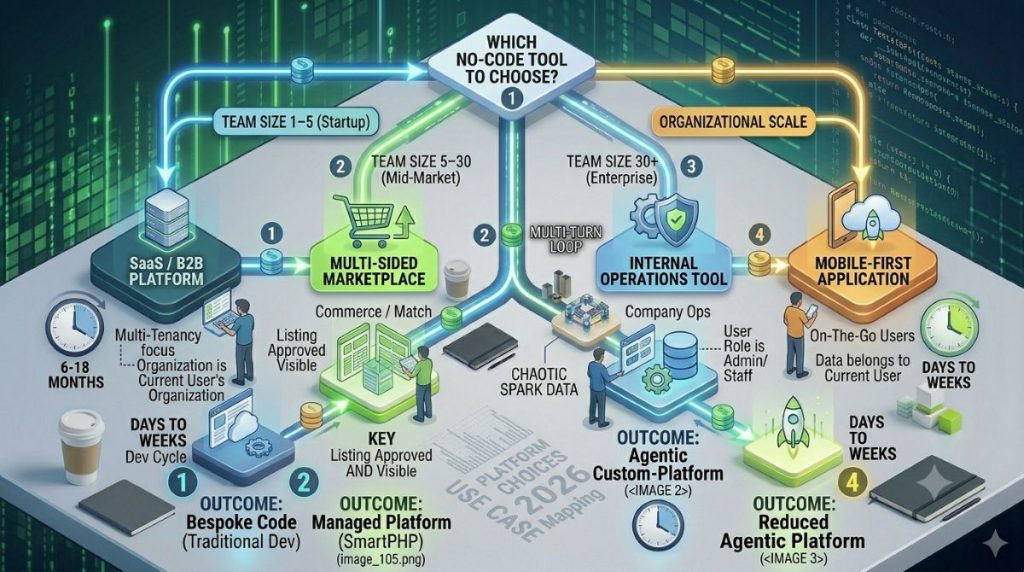
Four questions help you find the closest Bubble reference for your concept:
1. Is the core experience web-based, or is mobile the primary product? Web → Bubble is the clear path. Mobile-primary → check the 2026 builder limitations against your specific needs first.
2. Does your logic need real-time financial processing or complex calculations? If yes, design for the orchestration pattern from day one. Bubble manages the experience; external APIs handle the calculation. Dividend Finance is the blueprint.
3. Are you building for internal users or external customers? Internal tools ship faster and need less front-end polish. External consumer products need more design investment.
4. What’s your real MVP window? Bubble’s speed edge is strongest at 4–12 weeks. Beyond that, the gap with traditional development narrows.
Closest match guide:
- Subscription SaaS → Teal, GoodCourse
- Marketplace → Comet, TicketRev
- AI-powered tool → My AskAI, TheHair.App
- Internal operational tool → Workello, Incomee
- Fintech or compliance app → Dividend Finance
If Bubble doesn’t seem like the right fit for your specific idea, our guide to choosing a no-code business app builder walks through the full decision framework. One correction worth making before you research further: Qoins, the debt-repayment app cited across many Bubble example lists, closed operations in June 2023 after bank partner complications and a lawsuit. It helped users pay off over $35M in debt and reached 10,000+ paying customers. A genuine validation story. But using it as a live benchmark in 2026 is inaccurate. SmartPHP flags this so your research reflects the current picture.
The Signal in These Examples
Every app in this guide — from Dividend Finance’s billion-dollar loan platform to Incomee’s solo-built freelancer tool — reached the same conclusion through different paths. Bubble is a production platform. Not a prototype environment. Not a shortcut that breaks at scale.
For non-developers in 2026, the technical risk of building on Bubble is lower than it’s ever been. The platform is stable, the ecosystem is deep, and the mobile category is now active. What remains is execution risk — how clearly you’ve defined your data model, how fast you’re willing to iterate with real users, and whether your idea sits in a category where Bubble has already mapped the terrain.
If one of the examples above looks like your idea, the path is well-worn. The question isn’t whether Bubble can build it. The question is when you start. For a broader view of the no-code development landscape beyond Bubble, our overview of low-code and no-code app development covers where the space is heading in 2026.
These fifteen examples span every category Bubble handles well — from billion-dollar fintech infrastructure to a solo founder’s laundromat POS system. The range isn’t coincidence. It reflects what happens when a platform gives non-technical operators the same productivity tools that were previously available only to engineering teams.
Frequently Asked Questions
Yes, with the right architecture. Bubble runs on AWS with horizontal scaling. Dedicated server instances are available on Scale and Enterprise plans, giving your app isolated compute resources. Dividend Finance processed billions in loan volume on Bubble by using the platform as a workflow layer, with complex calculations in external APIs. At high scale, the key decision is what Bubble handles versus what runs externally.
Dividend Finance is the most documented high-scale build — a fintech platform that raised $365M+ and processed over $1B in loans before adding in-house engineers to complement the Bubble layer. At consumer volume, Teal with 2M+ members represents significant SaaS scale. Both show that Bubble handles complexity through smart architecture, not raw platform power.
The native mobile builder entered public beta in 2025 and can ship iOS and Android apps. For web products with a mobile companion, it’s a practical option now. For mobile-first consumer apps where speed and native device access are the core experience, the builder is still developing — third-party testing found 8–14 second load times in beta. Evaluate your specific needs rather than assuming full parity with dedicated mobile platforms.
MVP timelines range from one week (simple demos like Airdev’s Not Real Twitter, built to show platform range) to 10–15 weeks for complex marketplace or SaaS products. Hello Prenup reached paying customers in weeks from a standing start. Dividend Finance launched an MVP in six weeks after a traditional dev team spent six months. The speed gain is real but depends on how precisely you’ve defined scope before building.
Real-time multiplayer games, hardware-dependent IoT systems, apps requiring low-level native mobile access like Bluetooth or AR, and applications with mandatory millisecond response times at very high transaction volumes. Bubble can approximate some of these with workarounds, but at high architectural cost. If any of these is the core of your product, evaluate purpose-built platforms first.