

Gartner projects that conversational AI deployments inside contact centers will trim agent labor costs by $80 billion in 2026, and that only requires automating one in ten interactions. That’s an enterprise headline. But the same technology powering those contact centers is now available to a five-person medical clinic, a solo e-commerce operator, or a home services business that misses calls on weekends.
The problem isn’t access. It’s clarity. Most pricing guides for AI voice agents are written by developers, for developers, or by enterprise software vendors with a product to move. There’s almost nothing for the business owner who wants to know what these things actually do, what they actually cost, and whether the math makes sense at their scale.
This guide covers all three: use cases organized by business type, a plain-English breakdown of how pricing is structured (including the components most vendors bury), and a practical framework for agencies pricing voice AI services for clients.
Why the timing matters: Gartner’s landmark forecast — $80 billion in contact center labor savings from conversational AI in 2026 — describes what happens when roughly one in ten interactions gets automated. The underlying infrastructure making those enterprise results possible now scales down to a five-person office. The global voice AI agents market reached $22.5 billion in 2026, with the small and medium enterprise segment growing at the fastest rate of any business size category (Precedence Research, 2026). The economics aren’t reserved for Fortune 500 budgets anymore.
What Are AI Voice Agents, Really?
An AI voice agent is software that handles spoken phone conversations on its own. It listens to a caller, interprets their intent using a large language model, and responds in natural speech in real time, without a human on the other end.
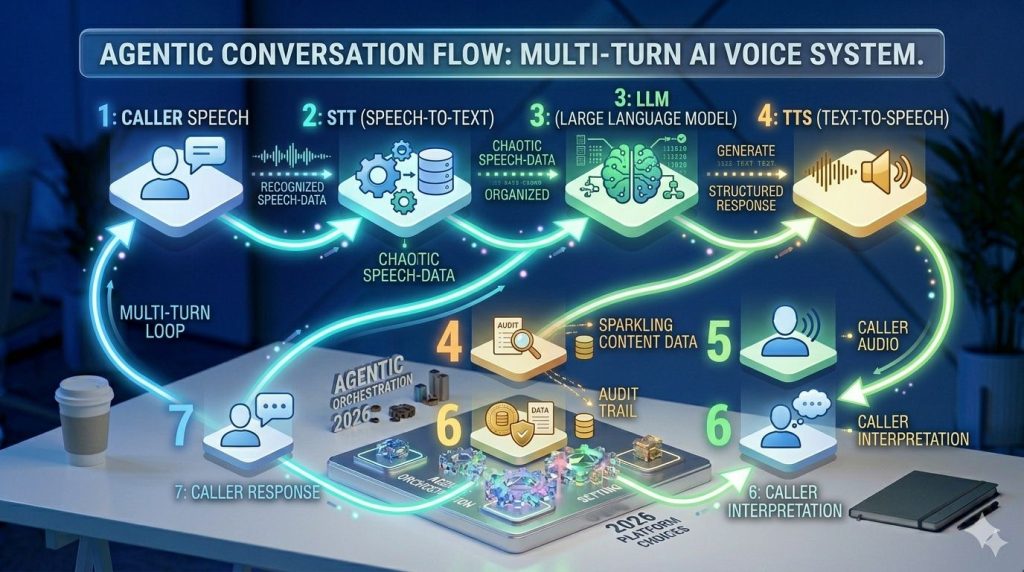
That’s fundamentally different from an IVR (interactive voice response) system. An IVR follows a fixed script: “Press 1 for billing, press 2 for support.” It breaks the moment a caller says anything unexpected. A voice agent understands full sentences. A caller can say “I need to reschedule my Thursday appointment to Friday afternoon” and the agent handles it, including pulling the calendar, checking availability, and confirming the change.
What makes modern systems Agentic AI Engineering Services powerful is the ability to take actions, not just answer questions. An agentic voice agent can look up a CRM record, book a calendar slot, trigger a follow-up email, or update an order status in real time. AI tools and automation are transforming modern workflows by enabling businesses to automate repetitive tasks, streamline operations, and improve efficiency. It’s not a chatbot reading from a script. It’s software connected to your business systems, acting on the caller’s behalf.
Three deployment modes exist in practice:
- Autonomous: the AI handles the entire call without human involvement. Best for high-volume, predictable tasks.
- Agent-assist: the AI supports a human rep in real time, surfacing information and prompting next steps.
- Hybrid: the AI handles the front of the call, gathers context, and transfers to a human with a structured summary.
Vapi, one of the leading developer-focused voice AI platforms, passed 1 billion total calls in May 2026 and now processes between 1 and 5 million calls per day. That’s not a pilot program. Voice AI is production infrastructure at this point.
What Can Voice AI Agents Actually Be Used For?
Most guides frame voice AI use cases around contact center categories: inbound support, outbound dialing, triage. That framing misses a large portion of the market. Here’s how real deployments break down by business type.
Healthcare and Medical Practices
Appointment scheduling is the most common entry point for healthcare, and the ROI case is immediate. A 12-physician practice that deployed a voice AI agent for after-hours booking reported 89% patient approval and saved $87,000 annually, the equivalent of two full-time admin roles, while extending service hours to 24/7.
The per-call economics behind that result are consistent across healthcare deployments: voice AI in medical settings costs $0.50 to $2.00 per call, while a live agent handling the same call runs $4 to $8. For any practice handling more than 3,000 calls per month, labor savings alone typically pay back the voice AI investment in 6 to 12 months — with missed-call revenue recovery adding another 20 to 40 percent on top of that (Linear Health, 2026). In 2024, 43% of US medical groups expanded their voice AI deployment, and 70% of those groups reported measurable operational improvements (NextLevel.AI / Healthcare AI Adoption Report, 2025).
Beyond scheduling, voice agents in healthcare handle prescription refill requests, post-visit follow-up calls, insurance eligibility checks, and medication reminders. Nearly half of U.S. hospitals plan to implement some form of voice AI by 2026, despite healthcare being one of the more compliance-intensive environments to deploy in.
HIPAA compliance is non-negotiable here. Any voice AI deployment in a healthcare context needs explicit data handling policies, call recording consent, and audit trails. Leading platforms like Retell AI and Bland.ai offer HIPAA-compatible configurations, but verify this specifically before signing any contract.
E-Commerce and Retail
The most common inbound call for an e-commerce business is “where is my order?” A voice agent can pull order status directly from your fulfillment system and answer that question without a human touching the call. At volume, that deflection alone can eliminate a meaningful portion of support overhead.
Broader use cases include returns and exchange processing, subscription management, and tracking updates. CloudTalk’s field test found that a deployed voice agent answered 100% of inbound calls, completed 96% of interactions without a human, and generated more than 70 qualified sales leads from contacts that had never previously spoken to a rep. That last result, outbound qualification, is often overlooked by operators who only think of voice AI for inbound.
Home Services and Local Businesses
For a plumber, HVAC company, or landscaper, every missed call is potentially a lost job. The “missed-call capture” use case is the simplest and most direct ROI play for small businesses: a voice agent picks up after-hours calls, takes job details, and books the callback or the appointment.
That one function often pays for the platform within the first month.
The missed-call problem is bigger than most owners realize. Research from industry trackers shows that contractors and home service businesses miss 60–80% of incoming calls — and for trades like HVAC, plumbing, and electrical, the average value of a single phone lead is $89 (ServiceTitan, 2025). At 80% missed-call rate on 50 weekly inbound calls, that’s $3,560 in potential revenue walking away every week. One small service business deploying AI answering saves an average of $23,000–$42,000 annually — roughly equivalent to replacing a part-time receptionist — once 24/7 coverage, appointment booking, and callback capture are factored together (AInora, 2026).
Financial Services and Insurance
Balance inquiries, loan eligibility screening, payment reminders, and collections are all high-volume, low-complexity calls that voice AI handles reliably. The banking, financial services, and insurance (BFSI) sector leads all industries in voice AI adoption, holding roughly 32.9% of total market share.
That 32.9% market share figure reflects a sustained multi-year investment: the call center AI market is projected to grow from $2.98 billion in 2026 to $13.52 billion by 2034 at a 20.8% CAGR (Fortune Business Insights, 2026). For BFSI specifically, the driver isn’t novelty — it’s cost. A human agent handling a balance inquiry or payment reminder costs $5.50 per interaction on average; an AI agent handling the same call costs $0.65 — an 88% reduction (ICMI Benchmark Report, 2025).
Outbound payment reminder campaigns are one area where voice AI consistently outperforms email. Contact rates are higher, and the conversational format reduces friction around sensitive topics.
Outbound Sales and Lead Qualification
A sales team spending hours calling unqualified leads is a common, expensive problem. Voice agents can screen inbound prospects at scale, ask qualification questions, and route conversations to a rep only when a lead meets defined criteria. Combined with CRM integration, the agent logs call outcomes, updates contact records, and triggers follow-up sequences without manual data entry — the same kind of workflow automation that no-code tools like Zapier and Make handle for digital tasks.
Customer satisfaction with AI voice interactions has reached 72% in 2026, up from 53% three years ago. That improvement is driven by lower latency, better natural language understanding, and more natural-sounding voice synthesis.
For a Smart Admin or small business owner, the practical starting point is picking one high-volume call type you currently handle manually. Don’t try to automate everything at once. Start there, measure cost per resolved call, and expand from that baseline.
The Hidden Cost Stack: What “Per Minute” Actually Means?
This is where most buyers get caught out. A vendor quotes $0.10 per minute. The bill arrives at $0.22. The gap isn’t a mistake. It’s the structure of how voice AI is built.
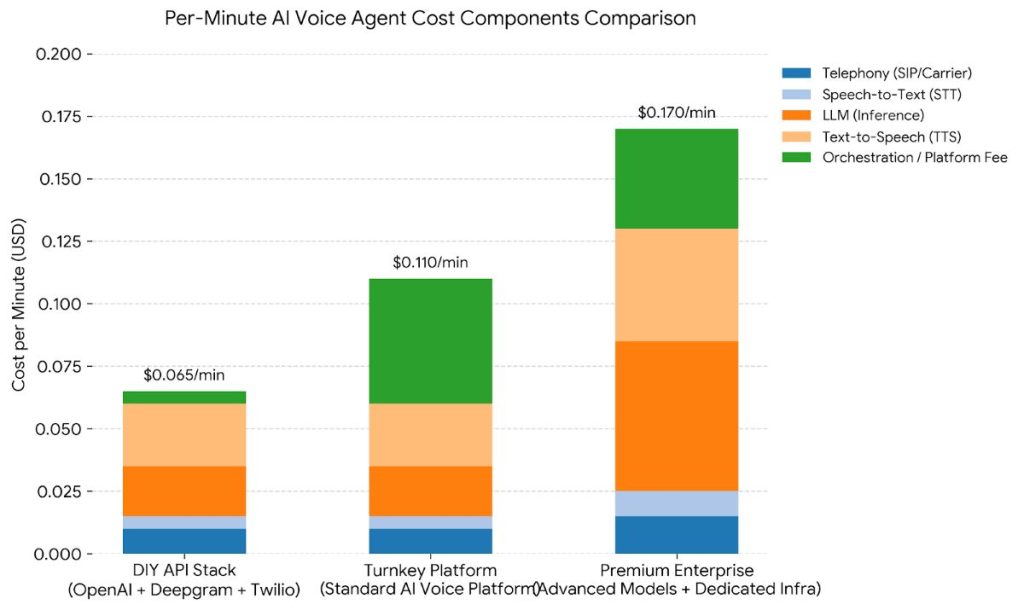
Every AI phone call runs on three stacked components for clients:
1. Speech-to-Text (STT): When the caller speaks, audio is converted to text in milliseconds. Leading providers like Deepgram, Whisper, and Google Cloud Speech-to-Text charge approximately $0.01–$0.02 per minute for this layer.
2. Large Language Model (LLM): The transcribed text hits the AI brain, which interprets intent and generates a response. Models like GPT-4o, Claude 3.5, or Google Gemini charge by tokens. During a typical call, that adds roughly $0.01–$0.04 per minute, depending on which model you’re using.
3. Text-to-Speech (TTS): The LLM’s response is converted back to a voice. High-quality synthesis from ElevenLabs or OpenAI costs more than generic TTS engines. Budget roughly $0.01–$0.03 per minute for a natural-sounding result.
Stack those three layers and you’re at $0.03–$0.09 per minute for the components alone, before any platform margin. An advertised rate of $0.05 per minute almost certainly doesn’t include all three.
Beyond the component stack, watch for these additional cost drivers:
- Integration fees: Connecting to an existing CRM or calendar may require custom development. Gartner estimates integration costs at $1,000–$2,000 per agent for enterprise deployments.
- Overage penalties: Exceeding included minutes on a subscription plan can trigger rates 2–3x the base per-minute price.
- Telephony costs: Inbound/outbound numbers, concurrent call lines, and international routing add to the total.
- Support tiers: Basic plans typically offer limited or no live support. Responsive technical assistance usually requires a paid upgrade.
The question to ask any provider before signing: “Does your per-minute rate include the LLM and TTS layers, or are those billed separately?” If the answer is “it depends on which model you choose,” budget an additional $0.04–$0.06 per minute on top of whatever rate they quoted.
Platform Pricing at a Glance: What Major Players Charge in 2026
The market has settled around two primary models: pay-per-minute for variable or low volume, and flat subscription for predictable, higher volume. Here’s how the main platforms compare.
| Platform | Model | Base Rate | Notes |
|---|---|---|---|
| Bland.ai | Pay-per-minute | $0.09/min flat | No setup fee; all-in; developer-friendly |
| Retell AI | Pay-per-minute | $0.07–$0.08/min (voice) + LLM separately | Most flexible LLM choice; enterprise from $0.05/min |
| JustCall | Hybrid | $99/month (100 min included) / $0.99/min PAYG | Best for light-to-medium inbound; CRM-integrated |
| CloudTalk | Volume-based | $0.25–$0.35/min | Volume discounts at scale; multilingual support |
| Enterprise subscription | Monthly flat | $1,200–$2,000/month avg | Unlimited or high-cap usage; SLA-backed |
JustCall’s Agent Lite plan at $99/month suits businesses handling under 200 minutes of AI calls monthly. Above that threshold, the $0.99/min overage gets expensive fast. A plan upgrade makes sense well before you hit that ceiling.
Bland.ai at $0.09/min is the simplest entry point for teams that want a working agent quickly, without negotiating a custom quote. The flat rate includes STT, LLM (their default model), and TTS.
Pay-as-you-go makes sense under roughly 500 minutes per month. Above that, subscription economics improve. A traditional answering service typically runs $800/month for basic after-hours coverage. A voice agent at $400/month delivers 24/7 intelligent handling with full integration capability.
How to Price AI Voice Agents for Clients?
This section is for agencies, consultants, and operators who build or resell voice AI services rather than buy them for internal use.
The most common pricing mistake is charging a flat monthly fee ($500/month, $1,000/month) without anchoring it to the value the agent delivers. Clients accept it initially, then question it when they don’t see a direct line between the cost and their outcomes.
The alternative is value-based pricing. Structure your fee as a percentage of the revenue or savings your agent generates. Charge 10–20% of what the deployment captures or saves. When the client sees the math, price resistance disappears because your service pays for itself five to ten times over.
Here’s the calculation in practice: a business missing 25 inbound calls per month, each worth $200, is leaving $5,000 on the table. A voice agent that reliably captures those calls delivers $5,000 in recovered revenue. Charging $500–$1,000/month for that result isn’t a cost. It’s a return.
Cost savings work the same way. A medical practice paying staff $150/hour to answer routine administrative calls, running 200 hours per month, has a $30,000/month labor exposure. A voice agent at $2,100–$3,000/month that handles the same volume is a 90% cost reduction. Pricing your service at $2,500/month isn’t aggressive. It’s conservative.
Your platform costs sit at $100–$400/month depending on call volume. The margin between platform cost and client fee is your operating profit. Build in a 30-day pilot before billing the full monthly rate. It lets you demonstrate results before the client has any reason to question the value.
Build vs Buy: Choosing the Right Setup for Your Budget
Three paths exist for getting an AI voice agent live.
All-in platform (Bland.ai, JustCall, CloudTalk): No code required. A non-developer can configure and launch a working agent in a few hours. Customization is limited to what the platform allows. Best for a single, well-defined use case with standard integrations. If you’re already using no-code platforms to run other parts of your business, the same evaluative framework applies here.
API-first builder (Retell AI, Vapi): Low-code. You get full control over the LLM, the voice, and the agent’s behavior. Requires some technical comfort or a developer for initial setup. The right choice when you need custom logic, unusual integrations, or want to choose your own LLM to control costs.
Real-world validation for the API-first route: In May 2026, Amazon Ring selected Vapi’s platform over 40 competing vendors for its customer support voice AI deployment — and the outcome was measurable. Jason Mitura, VP of Software Development at Amazon Ring, confirmed that Ring’s customer satisfaction scores improved after the rollout, and noted that “teams were able to tune the AI agent experience without depending on engineering.” The underlying Vapi infrastructure: sub-500ms latency, modular LLM and voice provider configuration, and a platform that keeps the complexity on the infrastructure side rather than pushing it to the operator.
Custom build (your own LLM API key + telephony stack via Twilio or Vonage): The cheapest per-minute cost ($0.02–$0.05 all-in at volume), but requires 40–80 hours of initial engineering. Reserved for high-volume deployments where per-minute economics justify the upfront investment.
For most Smart Admins, the path is clear: start with an all-in platform for your first use case. Don’t optimize for the lowest per-minute rate before you’ve validated that voice AI works for your specific call type.
Five questions to ask any provider before committing:
- Does the per-minute rate include the LLM and TTS layers?
- Which LLMs can I choose between, and do premium models cost more?
- What happens when I go over my included minutes?
- How does the agent integrate with my CRM or calendar system?
- What’s the minimum contract term?
The ROI Math: Does It Actually Work at Small Scale?
At the per-call level, the numbers are stark. A voice AI call costs roughly $0.40 all-in. A human-handled call costs $7–$12. That’s a 90–95% cost reduction per automated interaction.
Healthcare organizations running automated calls report handling them at 10–15% of the cost of an equivalent human-handled call. A Forrester Consulting study on voice AI deployments found a composite organization saved $10.3 million over three years, with ROI between 331–391% and payback under six months.
Those are large-scale numbers. The small-business math is simpler: if a voice agent handles 150 calls per month that would otherwise cost $20 each in staff time ($3,000/month in absorbed labor cost) and the platform runs $200–$400/month, the monthly net benefit is $2,600–$2,800. That’s not a marginal win.
One realistic caveat: a voice agent that handles your specific call types well takes days to tune, not hours to configure. Budget for the initial build realistically, and don’t judge the economics until the agent has run for at least 30 days.
By 2028, AI is projected to handle 70% of first-contact phone interactions. The question for business owners isn’t whether voice AI fits. It’s which call type to start with, and which platform to run your first 30-day pilot on.
Frequently Asked Questions
A traditional IVR (interactive voice response) system uses rigid menu trees and fails when callers deviate from expected inputs. A voice AI agent uses natural language processing to understand full sentences, interpret intent, and respond dynamically. Unlike IVR, a voice agent can take actions — booking an appointment, pulling a CRM record, triggering a follow-up email — based on what the caller says. For callers, voice AI feels like a real conversation. IVR feels like navigating a phone maze.
A custom build using your own LLM API key and a telephony provider like Twilio or Vonage can run $0.02–$0.05 per minute at volume. The real cost is setup time: expect 40–80 hours of developer work for initial configuration, plus 20–40 hours of testing before the agent handles real calls reliably. Most businesses are better served by an API-first platform like Retell AI or Vapi for the first deployment, then considering a custom stack once call volume justifies the engineering investment.
Yes, and that’s one of their core operational advantages over human agents. A single human handles one call at a time. An AI voice agent can handle hundreds of concurrent calls without degradation in response quality or wait time. For businesses with call spikes — busy seasons, promotional campaigns, after-hours surges — unlimited concurrency means every caller is answered immediately. Most platforms bill by total minutes consumed, not by concurrency, so handling 50 simultaneous calls doesn’t cost more per call than handling 5.
Banking, financial services, and insurance (BFSI) lead adoption with roughly 32.9% of total market share, using voice agents for account services, fraud detection, and payment reminders. Healthcare is the fastest-growing vertical, with appointment scheduling and patient follow-up as the primary entry points. E-commerce uses voice AI heavily for order status and returns. Home services and professional services are seeing rapid adoption for after-hours call capture and lead qualification. Customer satisfaction rates across industries have reached 72% as of 2026.
For most business owners, a no-code all-in platform is the right starting point. Platforms like Bland.ai, JustCall, and CloudTalk can have a working agent live in hours, without writing a line of code. The per-minute cost is higher than a custom build, but the time-to-value is dramatically faster, and you’re not dependent on a developer for every change. Build your own stack only if you’re handling high call volume (1,000+ minutes per month), need a specific LLM your platform doesn’t support, or require integrations that no existing platform accommodates. The custom route saves on per-minute cost but adds months of setup and ongoing maintenance.
More than most owners expect. Industry data shows that contractors and home service businesses miss 60–80% of inbound calls, with each missed lead representing $200 to $2,000 in potential revenue depending on the service type (ServiceTitan, 2025). For a plumber handling 30 inbound calls per week, missing 20 of them at a $300 average job value is $6,000 in lost revenue weekly. A voice agent at $200–$400/month that captures even half of those callbacks doesn’t just “pay for itself” — it generates a 30–40× return on the platform cost in recovered revenue alone. The ROI math is most direct for any business where calls come in at unpredictable hours and each unanswered call is a paying customer going elsewhere.