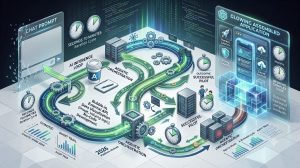

Lovable is an AI app builder that turns plain-language descriptions into working full-stack web applications. You type what you want in a chat box — “a booking app where clients pick a time slot and pay a deposit” — and the AI generates the interface, writes the code, sets up the database, and deploys a live application. No manual coding required to start, and you own the code it produces.
This guide explains what Lovable actually is, how the AI turns a sentence into a working app, what it can and can’t build, and who it’s genuinely for. We’ve tested it against the other AI app builders it competes with and rated where it earns its place — written for the business owner or non-developer trying to understand the tool before committing time to it.
What Is Lovable, Exactly?
Lovable is an AI-powered development platform in the category people now call “vibe coding” — building software by describing it in natural language and refining it through chat, instead of hand-writing every line of code. You bring the idea and the judgment; the AI does the code generation.
It’s not a drag-and-drop website builder, and it’s not a template gallery. Lovable uses large language models to generate a genuine codebase — real React and TypeScript, a real database, real authentication — the same building blocks a human development team would use, produced by artificial intelligence from your prompt.
The tool has a serious pedigree. It started as an open-source project called GPT Engineer that collected more than 50,000 GitHub stars, launched commercially as Lovable in November 2024, and hit number one on Product Hunt. By 2026 it had passed 2.3 million users and roughly $100 million in annual recurring revenue, with a $330 million funding round backed by Nvidia and Salesforce. It reached $20 million in annual revenue in about two months — the fastest growth in European startup history. This is established infrastructure, not an experiment.
How Lovable Actually Works
The magic is really a sequence of steps the AI handles for you. Here’s what happens between your prompt and a live app.
You describe the app in plain language. A sentence or a paragraph is enough to start: what the app does, who it’s for, what the main screens of your app are. Whether you’re building a web app or a mobile-friendly application, this is the prompt — and the quality of your description shapes the quality of the app you get back.
The AI generates the code. Lovable’s machine learning models interpret your request and generate a full-stack application — including the front-end interface, underlying code, data structure, and the logic connecting everything. For businesses that need more advanced customization, Lovable Development Services can help refine the generated application, integrate custom functionality, and prepare it for scalable production use. In early 2026, Lovable added Plan Mode, where the AI shows you a build plan before writing any code, allowing you to review and adjust the approach before development begins.
You refine it through chat. The app appears in a live preview beside the chat. You ask for changes in plain language — “make the header sticky, move the sign-up button to the top” — and the AI regenerates the affected code. Small text and styling fixes can be made directly in a visual preview toolbar without spending credits.
You connect a database when you need one. When your app needs to store data or sign users in, Lovable connects to Supabase — an open-source backend providing a PostgreSQL database, user authentication, file storage, and serverless functions. You describe what you need (“let users log in and save their own tasks”) and the AI generates the database tables and wiring automatically.
You deploy. One click publishes the app to a Lovable subdomain, a custom domain, or your own hosting through GitHub sync to Netlify or Vercel. The code is yours — it exports cleanly to GitHub with no vendor lock-in.
The whole loop, from prompt to deployed app, can take minutes for something simple and a few hours for something with real features. That speed is the entire point of an AI development company, helping businesses turn ideas into functional AI-powered applications faster.
What Lovable Builds, and the Tech Underneath
Lovable generates full-stack web applications. Under the hood, every project is built on a consistent, modern technology stack: a React and TypeScript front-end styled with Tailwind CSS, a PostgreSQL database through Supabase, built-in authentication, and one-click deployment. You don’t need to know any of those technologies to use Lovable — but because it generates real code in real frameworks, a developer can pick the project up and maintain it like any other codebase.
What can you build with it? SaaS apps, internal business tools, client portal apps, booking apps, dashboard apps, marketplace apps, landing pages with logic, and MVPs of almost any web or mobile-friendly application. If you can describe the app, Lovable can generate a working version of it. Because the apps are built with responsive web design, they work across desktop and mobile browsers — though one honest limitation matters: Lovable builds web applications, not native iOS or Android mobile apps. Your app will run well as a mobile web app, but it won’t ship to the Apple App Store or Google Play as a native mobile application. For most business tools and MVPs, a responsive web app is exactly what’s needed; for a true native mobile app, Lovable isn’t the right tool. AI app builders are making application development more accessible to beginners and non-developers. If you’re looking to build practical capabilities in this area, explore these AI skills to learn in 2027.
Lovable’s Key Features in 2026
The platform has matured well beyond simple prompt-to-app. The features that matter most for how it actually works today:
Plan Mode — the AI presents a detailed build plan before generating code, so you review and approve the approach first, the way a design review works.
Draw-to-Build — sketch UI elements directly on the canvas and the AI converts your drawing into production code and interface design.
Prompt Queue — stack up to 50 prompts and let the AI execute them in sequence, useful for batch changes across an app.
Browser Testing — a virtual browser environment where Lovable automatically tests your app, catching visual bugs and interaction issues before you ship.
Voice Mode — describe changes by speaking instead of typing, which suits people who think out loud.
Built-in image generation — the AI generates images directly inside the builder, including transparent backgrounds for icons and UI elements, with no separate tool needed.
Claude MCP integration — build, deploy, and manage Lovable apps directly from Claude or the Claude Code terminal, connecting the AI app builder to a broader AI development workflow.
What Lovable Is Great At — and Where It Isn’t
After testing across the field, the honest picture: Lovable is excellent at getting from idea to working prototype fast. In our assessment it rates as one of the best AI app builders of 2026 for MVPs, SaaS prototypes, demos, proof-of-concepts, and internal tools — and reviewers who’ve built dozens of production apps with it consistently rate it at or near the top of the category. Its Supabase integration for databases and authentication is best-in-class, and on a straight feature-for-price comparison against Bolt, Base44, and v0, it scores well for teams and rapid prototyping.
Where it needs help: complex, multi-step business logic can confuse the AI, and heavy debugging burns through credits quickly. More importantly, production applications still need human review — for security, for scalability, and for architecture — before real users and real data depend on them. Lovable generates the code; it doesn’t replace the judgment of someone who understands what a secure, scalable application requires. The most experienced users treat it as an AI co-engineer that does the heavy lifting on the first 80%, not as a full replacement for software engineering.
How Lovable Rates: Our Quick Verdict
Scored against the other AI app builders in this category, here’s how Lovable stacks up:
Ease of use — excellent. The plain-language prompt interface is the most approachable of any AI app builder we tested. A non-developer can build a working app on day one.
Capability — very strong. Full-stack generation, real code, Supabase backend, and one-click deployment put it ahead of most competitors on raw capability for web apps.
Value — strong for teams. At $25/month with unlimited collaborators, it rates well in a price comparison against per-seat rivals, though heavy prompt iteration consumes credits quickly.
Mobile app support — limited. This is the one category where Lovable rates below app-focused competitors: it builds responsive web apps, not native mobile apps for the iOS or Android app stores.
Overall verdict: the best AI app builder available in 2026 for building and shipping web applications fast, provided you treat it as an AI co-engineer rather than a full replacement for developer review. For a native mobile app, look elsewhere; for almost anything else on the web, it’s the top-rated pick.
Who Should Use Lovable?
Lovable is a strong fit for a non-technical founder validating a business idea, a small team building an internal tool without a developer to spare, a designer turning a concept into a working product, or a developer who wants to skip the tedious scaffolding at the start of a project. If you can describe what you want clearly and you’re building a web application rather than a native mobile app, it will save you enormous time.
It rates as a weaker fit for complex enterprise systems, highly regulated environments that demand exhaustive security review, or anyone who needs a true native mobile app for the app stores rather than a mobile-friendly web app. And if you have no interest in reviewing what the AI produces before real users touch it, that’s a risk regardless of the tool.
Getting Started: A Best-Practices Guide
A few practices separate a smooth first build from a frustrating one. Plan before you prompt — sketch your screens or write a short description of what the app does and who it’s for; better input produces better AI output. Build the interface and flow first, then connect the database once the layout is settled, so your data model fits a stable design. Make changes in small batches of two or three rather than one giant prompt, which keeps the AI’s output accurate and uses fewer credits. Use the free visual preview toolbar for copy and styling fixes instead of spending a credit-consuming prompt on them. And sync to GitHub early, so you always have a version history of the generated code you can roll back to.
Frequently Asked Questions
Lovable is an AI-powered app builder that turns natural-language prompts into working full-stack web applications. You describe the app you want, and the AI generates the interface, code, database, and authentication, then deploys it — no manual coding needed to start, and you own the code it produces.
You describe your app in plain language, the AI generates a full-stack application (React front-end, Supabase database, authentication), you refine it through chat with a live preview, connect a database when you need to store data, and deploy in one click to a subdomain, custom domain, or your own hosting via GitHub. The AI handles the code generation; you handle the description and review.
Lovable.dev is the official website and platform for the Lovable AI app builder. It’s where you sign in, describe your app, and use the AI development environment to build, refine, and deploy web applications.
It feels no-code at the prompt layer — you don’t have to write any code to build an app — but it generates real, editable code underneath that syncs to GitHub. That makes it more flexible than a traditional no-code drag-and-drop builder, because a developer can take the code over at any point.
Lovable builds responsive web apps that work well as mobile apps in a browser, but it does not produce native iOS or Android apps for the app stores. For a mobile web app — an app your users open in a browser on their phone — it’s a strong fit. For a true native mobile app installed from the app store, you’d need a dedicated mobile app builder instead. Many businesses find a responsive web app covers their mobile app needs without the cost of native development.
Lovable has a free plan at $0/month with a small daily credit allowance for testing, and paid plans starting at $25/month for more credits, custom domains, and private projects. Every prompt consumes credits scaled to the complexity of the request.
The Bottom Line
Lovable is the clearest example yet of what AI app builders have become: describe software in plain language, and artificial intelligence generates a real, deployable, full-stack application you own. It won’t replace an engineer’s judgment for production systems, and it won’t build you a native mobile app for the app stores. But for turning an app idea into a working web application faster than any traditional development process, we rate it one of the best AI app builders available in 2026 — and genuinely usable by people who have never written a line of code. If you’re building a web or mobile-friendly app and want a tested, top-rated starting point, Lovable earns the recommendation.